
Private Energy Partners is exploring the potential for a Battery Energy Storage System (BESS) to be located in Uriarra, ACT.
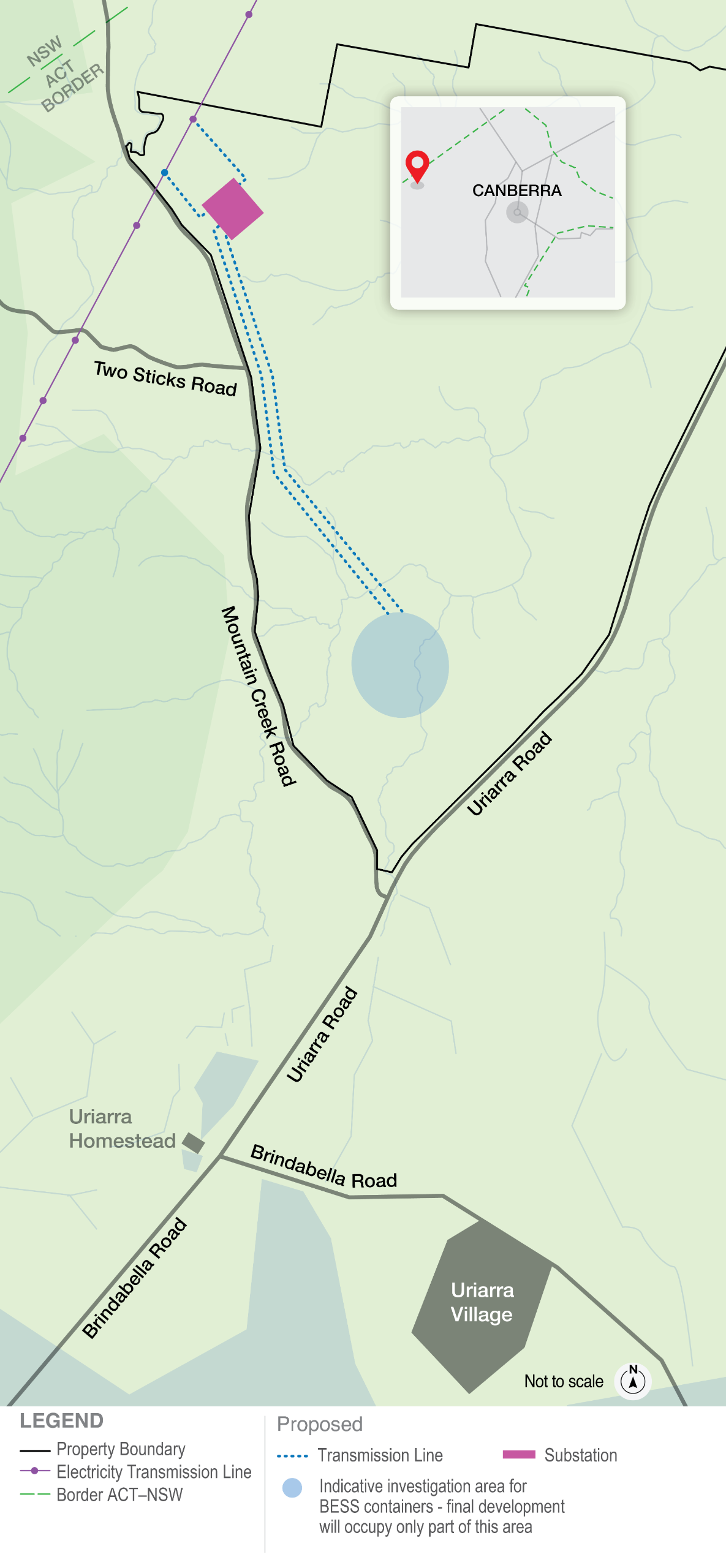
The proposed development, known as Flat Rock Energy Storage, would be located approximately 2km north-west of Uriarra Village. It would store electricity when demand is low and then release it to the grid when it is needed most. The development would play a significant role in improving energy security, grid reliability and resilience.
A Land Management Agreement is currently in place for Uriarra Station and most of the property will continue to be used for grazing.
Quinbrook acquired the land rights for Uriarra Station in May 2026. Private Energy Partners is Quinbrook’s development and delivery arm.
About Flat Rock Energy Storage
We’re proposing to deliver a grid-scale BESS and associated electrical substation, along with connections to the electricity grid. The project’s capacity and storage duration are yet to be confirmed, pending the outcome of site and technical assessments.
We are in the early planning stages and expect the development footprint would require approximately 10 per cent of the total property size.
The project will incorporate the latest industry technology and meet all applicable safety, planning and environmental requirements under ACT and Commonwealth legislation. Its design and layout will be carefully structured to minimise impacts on the surrounding landscape, protect local cultural heritage and be considerate of neighbouring communities.
Key infrastructure is likely to include:
- Battery units and containers
- Transformers
- Cooling and ventilation systems
- Electrical substation
- Fire detection and suppression systems
- Site office and amenities for operational use
- Transmission lines to connect to the new substation.
Acknowledging Uriarra's cultural and environmental heritage
We recognise the historical, cultural and environmental significance of the Uriarra region. We are committed to protecting heritage values, complying with all cultural heritage obligations and engaging in a timely and culturally appropriate way with Traditional Owners and relevant Indigenous bodies and agencies.
Before any work proceeds, we’ll complete a number of technical assessments to identify and respond to any potential impacts to:
- Cultural heritage and Traditional Owner values
- Fire and emergency risk
- Hydrology and water management
- Biodiversity and ecological sensitivities
- Noise, traffic and visual impact
Project layout - schematic map only
What is a BESS?
A BESS is a large-scale battery that stores electricity and then releases it back to the grid when it is needed during periods of high demand, or when other generation sources aren’t producing enough power.
As Australia transitions to more wind and solar generation, grid-scale storage is becoming essential to keeping electricity supply reliable around the clock.
A safe project, by design
Any BESS development will meet all Australian safety standards and will be built to international best practice. Safety is built into every stage of our planning – from site design through to emergency response.
Safety measures will include independent fire risk assessments, built-in fire detection and suppression systems in every battery unit and an Emergency Response Plan developed in collaboration with local fire and emergency services.
BESS safety systems
Safety first – always. The wellbeing of neighbours, the community and workers is always our highest priority.
The BESS would use components from manufacturers with a strong history of meeting international safety standards. It will also be designed and installed in line with the Australian standards for energy storage systems.
Industry-standard grid-scale Lithium Iron Phosphate (LFP) batteries, one of the safest operations for large-scale energy storage, would be used in the BESS.
LFP is a type of battery chemistry that uses iron and phosphate rather than nickel and cobalt. Compared with some other chemistries, LFP is generally more thermally stable and less prone to overheating. LFP batteries are increasingly used in caravans, motorhomes, boats and household energy storage.
BESS fires are considered highly unlikely due to multiple layers of safety design. However, as part of our planning, we will prioritise fire safety and prevention, and emergency response in the unlikely event of a fire.
- Safety Systems: In-built mechanisms will automatically detect fire, allow battery ventilation and manage temperature across the system.
- Proper setup: Equipment will be carefully designed, built and installed to meet safety standards.
- Smart monitoring: Sensors and automated controls will detect faults and shut batteries down if a fault is detected.
- Fire safety: Each unit will include advanced fire detection and suppression systems which automatically activate if high temperatures are detected.
- Containment: Battery containers will be fire-resistant and able to hold fire inside without it spreading.
- Remote control: The fire suppression system will be able to be activated from a distance if needed.
- Environmental protection: Water used in firefighting will be stored in drains and retention ponds, which will be safely contained by shut-off valves and only discharged after the water has passed stringent quality checks.
- Heat management: Batteries and inverters produce heat during operation. The BESS will have features to ensure safe and efficient equipment performance, including liquid cooling fans and ventilation systems to keep temperatures within a safe operating range.
- Engaging with local emergency services: We will work closely with local emergency services to ensure emergency response preparedness throughout project planning and operations.